






8 Days Motorcycle Tour from Ouarzazate to Merzouga Desert Ride
8 Days Motorcycle Tour from Ouarzazate to Merzouga Desert: Ride into the Soul of Morocco
The 8 days motorcycle tour from Ouarzazate is one of the most rewarding desert adventures in Morocco, blending rugged off-road riding with rich cultural encounters and dramatic landscapes. From the red-earth kasbahs of the Draa Valley to the golden dunes of Merzouga and the twisting canyons of the Atlas Mountains, this journey takes you far beyond the typical travel routes. If you’re looking for something raw, real, and unforgettable, this tour delivers it all.
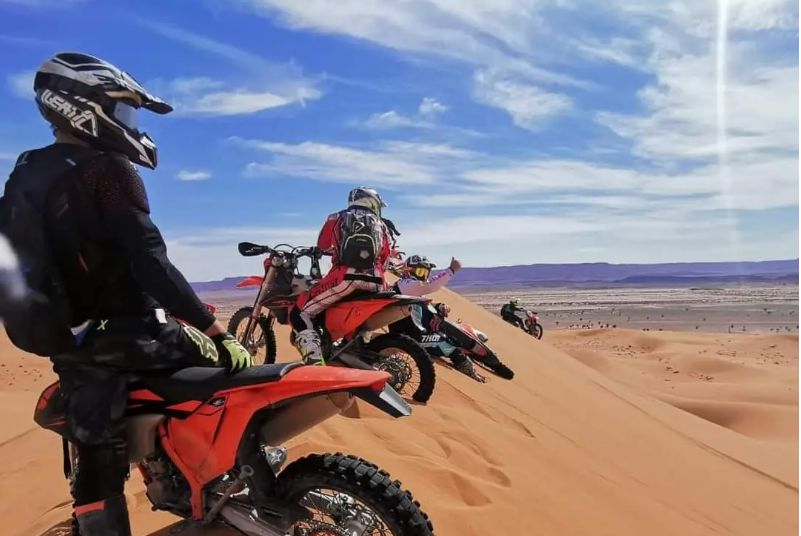
Starting and ending in Ouarzazate, the tour loops through Morocco’s most spectacular and diverse terrain: deserts, dunes, mountains, gorges, and oasis valleys. You’ll travel on a mix of paved roads, gravel tracks, Dakar rally trails, and sandy desert paths that test your riding skills and awaken your senses. With full support from our professional guide and 4×4 crew, you can focus on the ride while we take care of the rest.
Day-by-Day Itinerary
Day 1: Ouarzazate to Zagora
Your 8 days motorcycle tour From Ouarzazate to Merzouga desert begins in Ouarzazate, the famous gateway to the Sahara and home to several major film studios. After a safety briefing and bike handover, you’ll ride south toward the vast Draa Valley. This ancient route once served as a passage for caravans heading to Timbuktu.
The road is lined with endless palm groves, mudbrick villages, and old kasbahs. Stop for a break at Agdz and visit the scenic Kasbah Tamnougalt, a hidden gem from the 16th century. Continue to Zagora, where the road begins to flirt with the true desert. Overnight in a cozy kasbah-style guesthouse.
Day 2: Zagora to Tafraout Sidi Ali
Leaving paved roads behind, you dive into the desert’s edge. Today’s ride is raw and peaceful. Ride through hamada(stone desert), small dunes, and winding off-road tracks. You’ll likely see camels, herders, and landscapes that look like a different planet.
Pass through barely populated hamlets and long-forgotten caravan routes. By late afternoon, reach Tafraout Sidi Ali, a remote Berber village nestled among barren hills. The silence out here is humbling. Stay in a local auberge or desert camp and enjoy a quiet evening with traditional food and stargazing.
Day 3: Tafraout to Ramliya
This section is made for true off-road lovers. You’ll cross technical sandy paths, rocky stretches, and wild desert flats that challenge your skills and reward your courage. The landscape opens up into vast emptiness, where you can ride for miles without seeing another soul.
Midway through the ride, you’ll pass fossil beds and dry riverbeds. Follow hidden tracks to Ramliya, a tiny, windswept village that feels like the end of the earth. Spend the night in a rustic desert auberge, surrounded by dunes and stars.
Day 4: Ramliya to Ouzina to Merzouga
Today’s ride features some of the best desert scenery on the tour. Start the morning riding over soft golden dunes and hard-packed sand between volcanic mountains. Cross the peaceful Ouzina dunes, a lesser-known but spectacular part of the Moroccan Sahara.
Stop in Ouzina village for tea with the locals and continue toward Merzouga, the gateway to the Erg Chebbi dunes. These towering dunes rise up to 150 meters and stretch as far as the eye can see. In the evening, take an optional camel ride to watch the sunset over the sand. Dinner and overnight in a luxury desert camp or a traditional kasbah.
Day 5: Merzouga to Todra Gorges
Ride out of the dunes and head north through Erfoud, a town known for its date palms and fossil markets. As you leave the desert behind, the terrain changes dramatically into rocky plateaus and green valleys.
Approach the impressive Todra Gorge, where massive cliffs rise vertically on both sides of a narrow riverbed. It’s one of the most photogenic stops of the tour. Walk along the river, enjoy the cooler air, and relax in a guesthouse nestled beneath the cliffs.
Day 6: Todra to Dades Valley
Today’s ride takes you into the High Atlas foothills. Climb through the winding Tissadrine Road, known for its thrilling switchbacks and panoramic views. Along the way, stop at unique rock formations like the “Monkey Fingers,” shaped by centuries of wind erosion.
You’ll pass through Berber villages built into the cliffs and see locals going about their daily lives. The ride ends in Dades Valley, where you’ll stay in a charming guesthouse overlooking the canyon.
Day 7: Dades to Valley of Roses to Skoura
Ride west through the stunning Valley of Roses, especially vibrant in spring when the pink flowers are in bloom. Stop in Kelaat M’Gouna, the heart of Morocco’s rosewater industry. You’ll ride through orchards, rose gardens, and riverside villages.
Continue to the Skoura Oasis, a green labyrinth of palms and hidden kasbahs. Visit Kasbah Amridil, one of Morocco’s best-preserved fortresses. Spend the night in a relaxing eco-lodge or riad surrounded by birdsong and date palms.
Day 8: Skoura to Ouarzazate
Your final ride is short but scenic. Ride through the foothills of the Atlas Mountains and back to Ouarzazate. Along the way, you can stop at Aït Benhaddou, a UNESCO-listed village made entirely of mudbrick and featured in movies like Gladiator and Game of Thrones.
Return to Ouarzazate by afternoon. Drop off the bikes, enjoy a final mint tea, and celebrate an unforgettable 8 days motorcycle tour from Ouarzazate.
.
PRIVATE JET TOUR ON CHOICE
Accommodations & Activities
Car Tour On Choice
INCLUDING PRESTATIONS
PRICES & AVAIBILITY
- Private Luxury Transportation Throughout The Tour.
- 4 Nights On Half Board in Palace Hotel Le Royal Mansour
- Personalized, Guided Tours in Key Destinations.
- Tour Desert On Camel For 2 Hours
- Quad Experience For 2 Hours
- Air Ballooning Experience Around Marrakech Villages For 2 Hours
- Buggy Experience For 2 Hours
- Parachut Jump With Photos & Videos Package
- All accomodations are in single room
- Airport Meet in Morocco and Greet with Private Transfers
- 24/7 MLV On-Call Support
- Internet access
- Meals (Not included )
- Entrance Fees, Taxes and All Gratuities Except Resident Tour Director
- Travel insurance ( Not included
- Fully equipped off-road motorcycle rental (KTM, Husqvarna, or equivalent)
- Professional bilingual motorcycle guide
- 4×4 support vehicle with mechanic and luggage transport
- 7 nights of accommodation (hotels, kasbahs, desert camps)
- All meals (breakfast, lunch, dinner)
- Drinking water during riding days
- Fuel for the full route
- Cultural stops, visits, and scenic detours
- Travel insurance
- Tips for guides and staff
- Optional activities (camel rides, hammam, sandboarding)
- Personal purchases
Packing Tips for the 6 Days Motorcycle Tour from Marrakech
- Motorcycle jacket (vented, with armor)
- Layered clothing: temps shift fast between desert, valley, and mountain
- Riding gloves and protective pants
- Hydration pack or refillable bottle
- Buff or scarf for sand/dust protection
- Sunglasses and sunblock
- Waterproof bag or backpack for small personal items
- Cash in Moroccan dirhams for remote stops
- Comfortable shoes for walking in gorges and kasbahs
- Camera or GoPro – you’re going to want it
YOU MAY LIKE ALSO
FAQ
Whether you need a visa depends on your nationality. You can submit and track applications for E-Visa or AEVM (Electronic Travel Authorizations to Morocco) through the Acces Maroc portal.
The maximum duration for a tourist trip is 90 days. If you need to stay longer, you can request an extension at the nearest police station for an additional 90 days.
Currency exchange is available at airports, banks, hotels, and city exchange offices. You’ll need to present your passport for the transaction.
Currency exchange is available at airports, banks, hotels, and city exchange offices. You’ll need to present your passport for the transaction.
Yes, international credit cards such as Visa and MasterCard are widely accepted in hotels, some restaurants, shops, and petrol stations. ATM machines for cash withdrawals are also widespread in Morocco.
Yes, you can find internet access at cafes, hotel lobbies, and occasionally free Wi-Fi in public areas. However, internet access in rural areas can be limited. A smartphone with the right plan can provide connectivity almost everywhere.
Both modern flushable toilets and Turkish toilets are available. Tours often aim to visit places with modern facilities.
No, it’s advised to drink bottled water and avoid using tap water for drinking or brushing your teeth. Bottled water is typically provided.
ATM machines are common in airports, metropolitan areas, and medinas but are rare in rural areas. Carry enough cash when traveling outside cities.
Public holidays vary annually due to the lunar calendar. Key holidays include:
- New Year’s Day: January 1
- Independence Manifesto Day: January 11
- Milad un Nabi (Prophet’s Birthday): Varies
- Labor Day: May 1
- Throne Day: July 30
- Eid al-Fitr: Varies
- Eid al-Adha: Varies
- Independence Day: November 18
Yes, Morocco prioritizes the safety of its visitors. To avoid issues, choose a reliable travel company and avoid suspicious places. Local authorities and police are available in tourist areas to address any concerns.
When visiting Morocco, wearing pants and a shirt is common and appropriate, as most locals dress this way. In rural areas, long pants and a long-sleeved shirt can offer protection from the sun and wind.
Pack essential items such as a hat, sunglasses, sunscreen, and insect repellent. Comfortable footwear is vital for extended walking. Consider bringing the following:
- Shawl or scarf: Useful as a wrap, headscarf, or sun shield.
- Comfortable shoes and sandals: A pair for all-day wear and flip-flops or lightweight sandals for comfort.
- Loose-fitting clothing: Choose lightweight, breathable fabrics to stay cool. Avoid tight clothing, and opt for tops with short sleeves or sleeveless styles.
Adapt your wardrobe to the season: layer in winter and opt for light outfits in summer. For formal occasions or upscale dining, bring appropriate attire like a dress or suit.
Yes, alcohol consumption is allowed in licensed venues such as hotels and restaurants. However, drinking in public places and transporting alcohol across the border is prohibited by law. As Morocco is a Muslim country, these restrictions align with local customs and regulations.
It’s challenging to obtain Moroccan Dirham outside the country as it’s a closed currency. Those who manage to do so often face high bank commissions. Once in Morocco, you’ll find ATMs, exchange points, and banks widely available. Many businesses, shops, and restaurants accept credit cards, though a 5% transaction fee is often applied.